Collaboration Is the Force Multiplier Behind Success in Aviation


Aviation rewards preparation—and punishes fragmentation.
Aircraft owners and operators don’t fail because they lack intelligence, capital, or access to expertise. They struggle because aviation decisions are made across silos: insurance here, finance there, legal somewhere else, maintenance opinions layered in late, and accountability spread thin.
The result is familiar:
decisions slow down
risk hides until it’s expensive
advisors work hard but out of sequence
owners are left reconciling conflicting guidance
This isn’t a competence problem.
It’s a coordination problem.
That’s why collaboration isn’t optional in aviation—it’s foundational. And it’s why the Aviation Association of Owners & Advisors (AAOA) exists: to establish collaboration as a professional discipline, not a casual afterthought.
Jump Menu
What Collaboration Really Means in Aviation
Why Collaboration Produces Better Outcomes for Aircraft Owners
Where Aviation Breaks Down Without Collaboration
The AAOA Model: A Unified Advisory Ecosystem
Aircraft Ownership Is a Team Sport
Why Collaboration Also Benefits Advisors
How to Build Collaboration That Actually Works
Frequently Asked Questions
What Collaboration Really Means in Aviation
In aviation, collaboration is often praised—and poorly executed.
True collaboration is not:
a referral swap
a loose network of “people I know”
a vendor directory
a conference badge and a LinkedIn connection
Real collaboration is operational. It has structure.
Effective collaboration means:
shared context (everyone understands the mission, constraints, and risk profile)
aligned incentives (no one benefits from withholding information)
clear sequencing (the right expertise enters at the right time)
defined accountability (decisions are owned, not diffused)
documented reasoning (what was decided—and why)
In short, collaboration is not speed
It’s discipline.
Why Collaboration Produces Better Outcomes for Aircraft Owners
Aircraft ownership sits at the intersection of finance, regulation, operations, liability, and risk transfer. No single advisor—no matter how experienced—sees the entire picture alone.
1. Collaboration surfaces risk earlier
The most damaging risks in aviation are rarely obvious upfront. They emerge later from:
transaction structure
insurance assumptions
operational profile mismatches
incomplete maintenance insight
legal or tax misalignment
When advisors collaborate early, those risks are exposed while options still exist.
2. Collaboration reduces decision friction
Owners don’t want more opinions—they want integrated judgment.
A collaborative advisory team delivers:
fewer contradictions
faster consensus
clearer tradeoffs
less re-litigation of settled decisions
3. Collaboration minimizes expensive rework
Aviation rework is costly:
coverage revisions
contract renegotiations
financing changes
operational restructuring
Early coordination prevents late-stage corrections.
4. Collaboration increases owner confidence
The ultimate value to an owner isn’t speed—it’s confidence.
Confidence comes from knowing a decision was:
stress-tested across disciplines
reviewed from multiple risk angles
aligned with long-term objectives
That confidence only comes from collaboration.
Where Aviation Breaks Down Without Collaboration
Aviation doesn’t lack expertise. It lacks integration.
Siloed specialties
Insurance, finance, legal, appraisal, and maintenance professionals often operate independently. Each performs well within their lane—but without coordination, gaps form between lanes.
Misaligned incentives
Too often, professionals are rewarded for “owning the client” rather than serving the outcome. That discourages transparency and delays involvement of other experts.
Inconsistent process
Many aviation transactions still rely on:
informal workflows
undocumented assumptions
manual handoffs
late-stage problem discovery
Talent alone can’t overcome structural fragmentation.
The AAOA Model: A Unified Advisory Ecosystem
The Aviation Association of Owners & Advisors (AAOA) was created to address this exact problem.
AAOA is not a trade group for one profession.
It’s a cross-disciplinary ecosystem designed to improve outcomes for aircraft owners and operators.
The purpose
Bring insurance, finance, legal, appraisal, and related experts into coordinated alignment
Establish collaboration as a professional standard
Improve decision quality, risk management, and execution consistency
The core belief
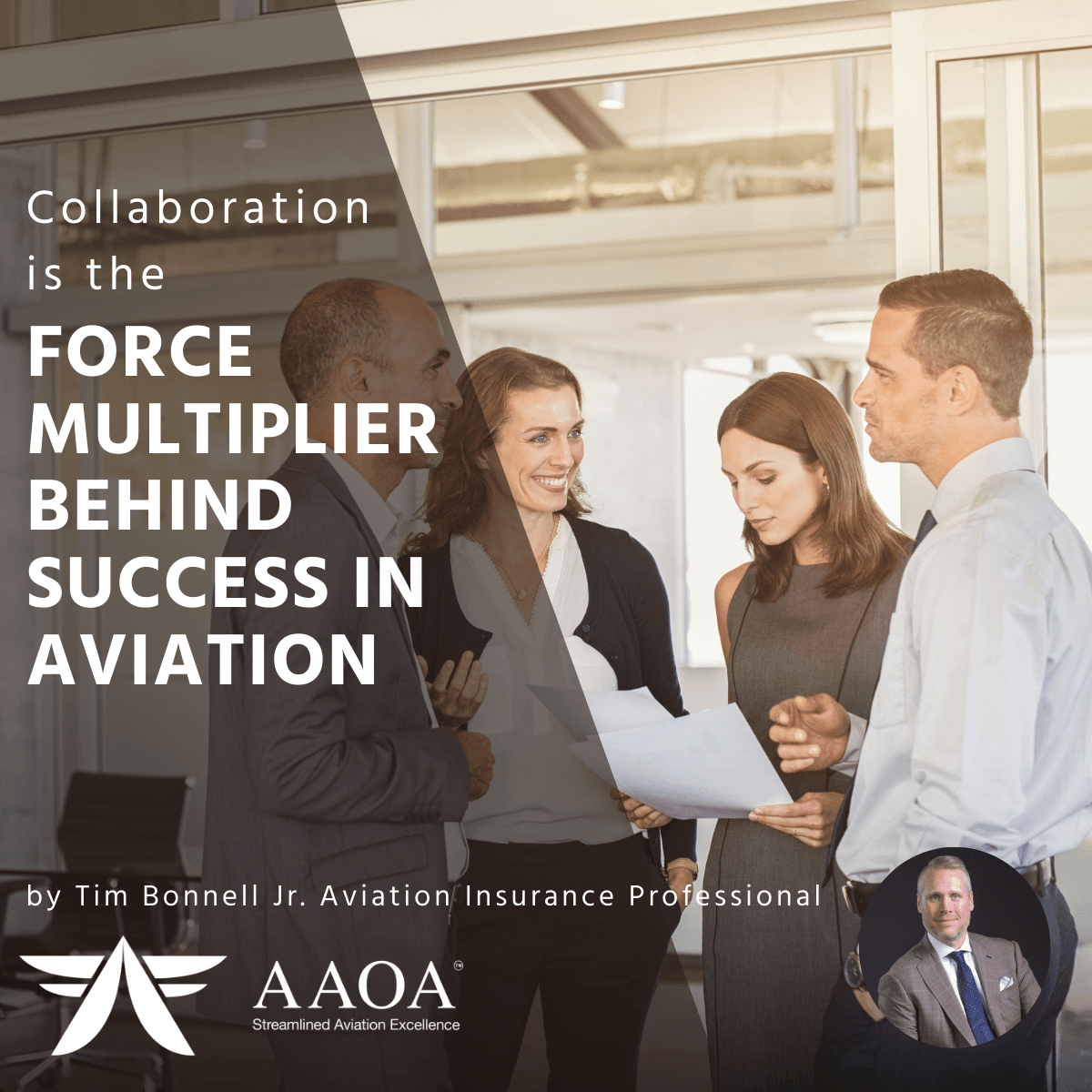
Collaboration is the force multiplier behind success in aviation.
When professionals coordinate, expertise compounds instead of colliding.
Aircraft Ownership Is a Team Sport
Every successful aircraft transaction follows the same pattern—even if it isn’t always intentional.
A collaboration-first ownership model:
Clear owner objectives
Mission, utilization, budget, risk tolerance, and timeline.
Early advisor alignment
Insurance, finance, legal, appraisal, and operational insight engaged before commitments are locked in.
Shared definitions of risk
Everyone agrees on what is acceptable—and what is not.
Parallel execution
Advisors work in concert, not in sequence.
Documented decisions
Decisions are recorded with rationale, not just outcomes.
This approach doesn’t eliminate risk—but it prevents preventable regret.
Why Collaboration Also Benefits Advisors
Collaboration isn’t altruism. It’s leverage.
Stronger credibility
Advisors operating within a coordinated ecosystem benefit from:
cleaner execution
fewer downstream issues
more consistent client experiences
Better inbound opportunities
Owners seek confidence. A collaborative ecosystem signals professionalism and reliability.
Authority and visibility
Collaboration naturally generates:
shared content
media mentions
backlinks
webinars and events
podcast participation
Authority isn’t manufactured—it’s accumulated through credible association.
How to Build Collaboration That Actually Works
Most collaboration efforts fail because they rely on intent instead of structure.
1. Put collaboration on the calendar
If collaboration matters, it must be scheduled:
regular outreach
joint events
shared content planning
recurring check-ins
2. Start with domino partners
A small number of respected, well-connected professionals create momentum faster than a large, unfocused group.
3. Standardize interaction
Clear expectations around communication, documentation, and handoffs are non-negotiable.
4. Design for mutual benefit
Collaboration must create value for:
aircraft owners
advisors
the ecosystem as a whole
Anything less won’t scale.
Frequently Asked Questions
What is AAOA?
AAOA is the Aviation Association of Owners & Advisors, a collaboration-driven ecosystem connecting aircraft owners and operators with coordinated advisory expertise across insurance, finance, legal, appraisal, and related disciplines.
Who is AAOA for?
Aircraft owners, operators, buyers, and the professionals who advise them.
Why does collaboration matter so much in aviation?
Because aviation decisions are interdependent. Fragmented advice creates hidden risk and delayed outcomes. Collaboration integrates expertise early.
Is AAOA a marketing organization?
No. Marketing can amplify collaboration, but it cannot replace disciplined coordination and professional alignment.
Final Thought
Aviation doesn’t reward lone operators.
It rewards well-coordinated teams.
For owners, collaboration means clearer decisions and fewer surprises.
For advisors, it means stronger credibility and better outcomes.
For the industry, it raises the standard of care.
That’s the role of AAOA.
The only remaining question is simple:
Who’s on your team?
About the Author -
Tim Bonnell Jr. is the Founder, President & CEO of Aeris Insurance Solutions. He is the author of the book Aircraft Insurance Fundamentals: A Concise Guide For Aircraft Owners and Operators and Aerial Application Insurance Fundamentals: A Concise Guide for Aerial Application Operations. He’s the host of the Aviation Insurance Podcast show. Tim’s a third-generation pilot and a second-generation aviation insurance broker. He was raised in the aviation insurance industry and had the opportunity to learn it from the ground up. His formal education was completed at Kansas State University.
Tim is a private and instrument-rated pilot. He holds the Certified Aviation Insurance Professional and Certified Insurance Counselor professional designations. In 2014, he was installed into the inaugural class of the Aviation Insurance Association’s Eagle Society. Tim has served on the boards of directors for the Aviation Insurance Association, Kansas Agricultural Aviation Association, National Agricultural Aviation Association, and the Wichita Aero Club in addition to other community organizations.
He is the Immediate Past Chair of the Aviation Insurance Association’s Education Committee and one of their lead instructors.
As CEO of Aereach Strategic Partners, my journey began with a challenge familiar to many: finding and retaining quality staff. Our breakthrough came when we embraced remote teams in the Philippines, leading to remarkable improvements in efficiency across our U.S. operations, from executive support to IT and marketing.
Our success with remote staffing, characterized by significant operational enhancements, led to the creation of Aereach Strategic Partners. We aim to share our proven blueprint for integrating global talent, ensuring our partners achieve the same level of success through refined remote engagement and comprehensive operational support and management practices.